
Custom software development for the work off-the-shelf apps can't handle
We build the internal tools, portals, and integrations your business runs on, or connect the apps you already pay for. Senior engineers plan, review, and test the work, and you own the code, docs, and accounts at the end.
Engagement commitments
- We'll tell you when buying is cheaper
- Security and launch plan in writing
- You own the code, docs, and accounts
A written plan, in plain English
You get this before any code is written, and you're free to stop there.
- Today
- How the work runs now, and where it slows you down
- Recommendation
- Buy, connect, or build, with the reasons
- Scope
- What's in, what's out, who can access what
- Plan
- Milestones, testing, and handover
Accelerated by
 Lovable
 Cursor
 Replit
 Copilot
 Kiro
Kiro Antigravity

 Figma MakeLovableCursorReplitCopilotKiroAntigravityFigma Make
When custom software development is worth it
If you've tried the off-the-shelf apps and your team still works out of spreadsheets, re-types the same data between tools, or chases approvals by email, custom software can close that gap. Not sure it applies to you? Ask us, and we'll give you a straight answer.
This is probably you if
- 01A process your team runs every week still depends on spreadsheets, email threads, or re-typing data between apps.
- 02The software you pay for covers most of the work, but not the part that sets your business apart.
- 03You need one new piece added to a system that works, and someone on your team owns the process.
When we'd tell you not to
- An app on the market already does this well without awkward workarounds. Buying it will cost you less than building.
- No one on your team owns this process day to day, or we can't speak with the people who actually do the work.
- You want every system replaced at once. We'd start with the process that costs you the most, not a full rebuild.
Buy, connect, or build
We rule out the cheaper options before we quote you a build.
Build
03The way you do this work sets your business apart, and no app on the market handles it well.
What we do
We build only the part that needs to be yours, designed around how your team already works, and hand over the code at the end.
You end up with
Software you own
What you take on
The most control, and the most to maintain
How we decide
We start with what you already pay for, what's available on the market, and what each option would cost to run over time. Then we recommend one of the three in writing, even when that means less custom work for us.
What we usually take on
- Internal tools, customer and supplier portals, quoting and approval systems, and integrations between the apps you already use.
- New features added to a system that already works, one at a time, so you aren't paying for a rebuild you didn't ask for.
- Logins and permissions, testing, a careful launch, the code itself, and written documentation so your team can take over.
Custom software has a running cost, every year you own it.
So build only the parts that pay for themselves, and subscribe to the rest.
Custom software can fit the way your business works in a way a subscription app never will. It also becomes yours to maintain: hosting, security updates, bug fixes, and someone to call when something goes wrong.
That's why we compare three options first: use what you already pay for, connect your existing apps, or build something new. Most projects end up as a mix, with custom code only where it clearly pays for itself.
- We show our reasoning
- You know the running costs
- Clear ownership after launch
Six deliverables you can review, question, and keep
So nothing important lives only in our heads. Which ones apply depends on the project, and your quote lists exactly which you'll get.
Current process and buy-or-build recommendation
1 of 6 · you review this before we build
Our recommendation
Build the approvals tool. Keep the existing CRM.
What you get
Current process and buy-or-build recommendation
A plain-English write-up of how the work runs today, the alternatives we looked at, our assumptions, and why we recommend buying, connecting, or building.
Your quote lists which of these you get, who reviews them, and what's out of scope.
What a custom software project can include
Every business runs differently, so we only build the parts your process needs. These are the six areas we work through with you.
- 01
The app your team uses
Screens, workflows, and business rules that match how the work really runs, including the exceptions.
- 02
Data and access
Logins, permissions, a record of who changed what, and how long data is kept.
- 03
Integrations
Your accounting, CRM, or supplier systems stay in sync without anyone re-typing data.
- 04
Additions to existing systems
A new feature built onto a system that already works, not a rebuild.
- 05
Testing and launch
We agree what "working" means, test against it, and plan how to undo a release if something goes wrong.
- 06
Documentation and handover
The code, the accounts, and written instructions so your team or another developer can take it over.
Four checkpoints, from first call to handover
We don't move to the next stage until the decision is written down, along with who made it and what's out of scope.
- 01
Understand the work
We talk with the people who do this work every week and document the rules, the exceptions, and what a good result looks like.
Success criteria agreed - 02
Agree what to build
You get our buy, connect, or build recommendation in writing, with what's in scope, what's out, and who is responsible for what.
Recommendation in writing - 03
Build in stages
We deliver one usable piece at a time. A senior engineer reviews all the code, and you try each piece before we move on.
You've tested and approved it - 04
Launch and hand over
We launch it, walk your team through running it, and hand over the code, documentation, and accounts.
Code and accounts handed over
Why this saves money
Why checking first saves you money
- We rule out cheaper options before quoting a build.
- The rules come from the people who do the work, not from assumptions.
- Security, testing, and launch are planned from the start, not added at the end.
- You get the code and the reasoning behind it, not a black box.
At every checkpoint you know what was decided, who decided it, and what's out of scope.
See our case studiesSimilar work we've delivered
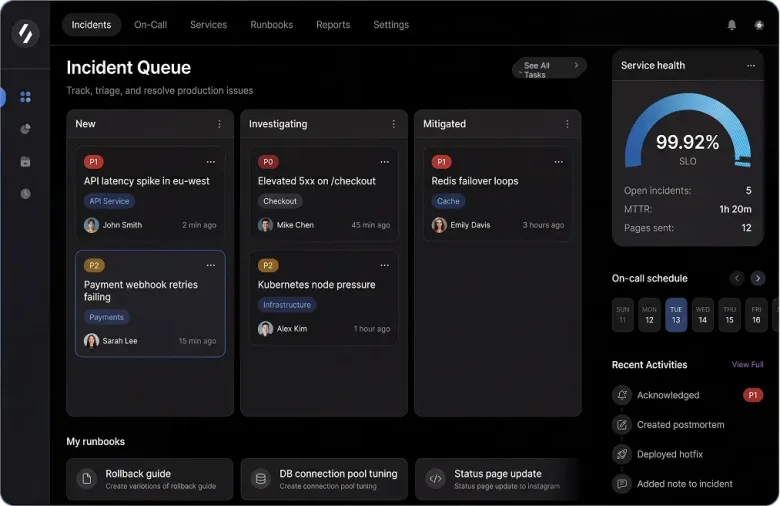
SLO
Modernized an 8-year-old monitoring platform in stages over six months, with no big-bang rewrite. Critical-path test coverage went from 40% to 78%.
Read the SLO case studyClipFlow
Rebuilt onboarding for a video collaboration SaaS in 8 weeks. Setup support tickets fell from 118 to 57 a month.
Read the ClipFlow case studyAtlasPulse
Made releases faster and more predictable for four product teams working on one platform in 10 weeks.
Read the AtlasPulse case study- SLO: median incident resolution, 79 to 49 minutes
- 38% faster
- ClipFlow: onboarding completion, 18% to 42%
- 2.3x
- AtlasPulse: median time to release, 9.1 to 5.1 days
- 44% faster

What custom software development costs, and how we quote it
Price depends on scope: the same feature can take two weeks or two months depending on your setup. Our starting prices are published, with MVP Build from $1,999 and Growth Partner from $2,999/mo. Larger custom builds take longer. After a free scoping call, you get a fixed quote for each stage.
Build one tool
One process, built and handed over: a quoting tool, an approval workflow, or an integration between two apps.
Tell us about the jobWhat's included
- The process you chose
- Logins, data, and integrations
- Testing, launch, and handover
What changes the price?
How complex the process is
How many people are involved, how many approval steps there are, and how many exceptions exist. The exceptions usually take the most time.
How sensitive the data is
Customer or payment data, access rules, and records you're required to keep all need extra care and testing.
The apps it connects to
Well-documented apps are quick to connect. Older or poorly documented systems can double the work, and we'll tell you early if yours is one of them.
How it launches
Software your team relies on all day needs more testing, a staged launch, and a clear way to undo a release. A simple internal tool needs less.
Your quote spells out what's included, what isn't, when you'll see each piece, and what would change the price. Working to a budget? Tell us on the first call.
Businesses with a clear problem to solve, and someone who owns it
Most of our custom software development work is for small and mid-sized businesses. It works best when we can talk to both the person who makes decisions and the people who do the work every day.
Owners and directors
You've compared what's on the market, and none of it fits how your business makes money.
Operations and office managers
Your team runs the same process every week, and no app you've tried matches how it really works.
In-house tech teams
You need one system built or integrated properly by senior engineers, without hiring for it.
Teams on an older system
It still works and can't go down, but one part of it badly needs replacing.
Build the part that sets you apart.Buy the rest.
Start with the smallest piece worth owning. We build it properly, test it, and hand over the code and documentation together. Tell us what you're working with, and we'll reply within one business day.
- You know the price before each stage starts
- Fixed quote per stage
- What's in, what's out, who can access what
- Clear scope
- Each stage works on its own, so you can change direction
- Pause after any stage
Custom software development: your questions
What is custom software development?
Custom software development means building software around the way your business already works, instead of changing how you work to fit an app you subscribe to. In practice, that's usually an internal tool, a customer or supplier portal, a quoting or approval system, or an integration between apps you already pay for. It also includes the less visible work: logins and permissions, testing, a careful launch, documentation, and handing the code over to you.
Should I buy software or build my own?
Buy if an app on the market already does the job and you can work within its limits. That's almost always cheaper. Connect your apps if each one works well on its own but your team re-types data between them. Build only when the way you do this work is part of what sets your business apart, and fitting it into someone else's app would mean constant workarounds. We put our recommendation in writing before you commit to a build, and if you don't need us, we'll say so.
How much does custom software cost?
Price depends on scope. The same feature can take two weeks or two months depending on the number of exceptions, approval steps, and older systems involved. Our starting prices are published on the home page: MVP Build from $1,999 and Growth Partner from $2,999/mo. Larger custom builds take longer and cost more. After a free scoping call, you get a fixed quote per stage that says what's included, what isn't, when you'll see each piece, and what would change the price.
Can you add to the system we already have?
Yes, as long as the part you want to change can be updated and released on its own. Before we change anything, we map what depends on what, how data moves through the system, and how we'd undo a release if needed. If what you really need is a full replacement or a move to a new platform, we'll tell you and price that separately rather than hiding a rebuild inside a small project.
How do you keep our data safe?
We identify early which data is sensitive, who should be able to see and change it, and what needs to be logged. From there we set up logins and permissions, keep passwords and API keys out of the code, agree what has to pass before each release, and plan how to undo one. Formal certifications and independent security audits stay with you and your own specialists. We won't claim to sign those off.
Who owns the code, and what happens after it launches?
You do. You get the repository, the accounts, documentation for running it, notes on the decisions we made and why, and an honest list of known limitations. After launch, you can keep us on for changes and support, or hand it to your own team or another developer. We set up the handover so either option works in practice.

Tell us about your project
Tell us what you're building, when you need it, and what's in the way. A senior engineer will reply within one business day with honest next steps, even if that means we're not the right fit.
- Your project is led by a senior engineer, not a junior and not AI on its own
- AI speeds up the build. Every change is reviewed and tested before it ships
- Best for MVPs, SaaS products, automation, and fixing apps that keep breaking