
Medical practice website design built around patient access
Custom, senior-engineered practice websites that let a patient confirm you take their insurance, see who will treat them, and book without phoning during office hours - all on accessible, fast pages.

Patients arrive with three questions. Most practice sites answer none of them
Do you take my insurance, who will treat me, and can I get an appointment. A patient who cannot answer all three from your first screen usually leaves rather than calls - and the practice two results down gets the visit. Meanwhile your front desk spends the day answering by phone the questions the website should have answered for free.
Insurance
is one of the first things patients check on a practice website
After hours
is when a large share of appointment intent arrives - and phone-only discards it
Accessible
is not optional in healthcare: practices serve patients with disabilities
None of this needs a redesign to start. Publishing your accepted plans and turning on online requests answers two of the three questions immediately.
The features that turn a search into a booked appointment
Every element exists to move a patient from a search to a confirmed appointment - and to take work off your front desk while doing it.
Real appointment booking
Online booking or requests wired into your scheduling system, so intent arriving at 9pm is captured rather than lost. Confirmations and reminders included, because no-shows are the other half of the problem.
Accepted insurance, listed plainly
The plans you take, in text, easy to find - plus self-pay guidance for common visits. This one page prevents more lost patients and more phone calls than anything else on the site.
Provider bios with real credentials
Every clinician named, with training, board certifications, and a real photograph. This is the strongest trust signal a practice site carries, and it is what search engines weigh as medical expertise.
A page per service or condition
Not one page listing everything. A genuine page per service, which is how patients search and how Google matches - and where the long-tail visits actually come from.
Secure intake, no plain-text inboxes
Encrypted transport, a proper privacy notice, sensible retention, and a Business Associate Agreement where a third party touches patient data. Clinical detail never arrives by ordinary email.
Accessibility and speed as requirements
Keyboard navigation, contrast, labelled forms, and screen-reader support treated as obligations rather than nice-to-haves - which also happens to be most of what technical SEO asks for.
Get found where patients actually search
The local practice search
Patients search for a service plus a place, then check hours and insurance. So we work on what Google weighs: a complete Google Business Profile with correct categories and hours, consistent citations across healthcare directories, steady reviews, and per-service pages that give Google the depth to match a specific condition rather than only your practice name. Hours that disagree between your site and your listing quietly cost visits.
Visibility in ChatGPT and AI Overviews
Patients now ask assistants for "a family doctor in [city] taking new patients who accepts [plan]." Being cited depends on structured, factual content a machine can read - named providers with credentials, explicit service lists, accepted insurance, correct hours, and Physician or MedicalClinic schema. Vague copy about compassionate care gives an assistant nothing to work with.
Both channels reward the same thing: plain, verifiable facts about who you are, what you treat, and whether a patient can be seen.
Why a custom-built practice website wins
Healthcare template platforms
Fast to launch, but you inherit fixed layouts, stock imagery, slow pages, and a site indistinguishable from every other practice on the platform. Accessibility is usually an afterthought, per-service depth is capped, and many platforms keep the site if you leave.
Our custom builds
Built around your specialties, your payer mix, and the patients you want. Accessible, fast, standards-compliant code; secure intake handled properly; full control over content and SEO; and no lock-in. You own the design, content, and domain.
Healthcare sites carry real obligations around privacy and accessibility. Those are engineering commitments, not template features.
Tailored to your specialty
A primary-care practice taking new patients is a different website from a referral-driven specialist, and neither is a multi-site group.
Primary care and family medicine
New-patient capacity, insurance, and booking dominate. Say plainly whether you are accepting.
Pediatrics
Parents decide, often urgently. Hours, sick-visit policy, and reassurance carry the page.
Specialists and referral practices
Referral-led, so the site validates a name. Credentials and condition depth do the work.
Dermatology
Medical and cosmetic sides need separate paths, with different proof for each.
Mental health and behavioral
Privacy and tone matter most. Low-friction, discreet inquiry paths convert best.
Urgent care and walk-in
Wait times, hours, and location are the entire decision. Speed on mobile is the feature.
Physical therapy and rehab
Condition-led searches plus insurance verification. Per-condition pages capture the demand.
Multi-site practice groups
A location and service matrix that scales without producing near-duplicate pages.
A clear process - from access audit to booked patients
Discovery and access audit
We map how a patient currently finds you and where the path breaks - the missing insurance list, the phone-only booking, the intake form nobody finishes.
Local and condition search analysis
Which practices hold the searches you want, which conditions you are invisible for, and which service terms nobody local has claimed properly.
Structure and content plan
A page per service or condition, provider pages that establish credentials, a location structure that will not duplicate, and the insurance and billing content patients hunt for.
Design and build
Custom design built by senior engineers, with accessibility tested rather than assumed, and pages that stay fast on a phone.
Booking, intake, and profile work
Scheduling integration tested end to end, secure intake with a proper privacy notice, Google Business Profile completed, and hours aligned everywhere.
Launch and measurement
Redirects mapped, rankings monitored through launch, analytics wired to appointments booked rather than pageviews.
Clear pricing for medical practices
Fixed scope, milestone billing, no hourly surprises. For context, custom medical practice websites across the market typically run $3,000-$30,000+; most of our practices land in the ranges below.
Starter practice site
2-3 weeks
From $2.5k
For a single-location practice that needs a credible, accessible site where patients can check insurance and request an appointment.
- Custom design, up to 6 pages
- Provider bios with credentials
- Accepted-insurance page
- Appointment request with secure form
- Google Business Profile setup
Growth site + local SEO
3-5 weeks
From $6k
For practices competing on condition and service searches, or operating across more than one location.
- Everything in Starter
- A page per service or condition
- Scheduling system integration
- Location pages without duplication
- Accessibility testing and remediation
- Local SEO and review flow
Practice growth partner
Monthly after launch
From $1.5k/mo
Ongoing content, local SEO, and conversion work for practices treating search as a durable source of new patients.
- Monthly condition and service content
- Local SEO and citation maintenance
- Conversion testing on booking paths
- Accessibility and performance monitoring
- Monthly reporting on appointments
What affects the price
- Number of services or conditions needing their own page
- Number of locations and providers
- Which scheduling system needs integrating
- Depth of secure intake and portal linking
- Whether accessibility remediation is needed on existing content
- Whether ongoing local SEO and content are included
Not sure what you need? Estimate your project cost or send us your details.
What the best medical practice websites do differently
Look at enough practice websites and the strong ones share six habits. None of them is about visual style.
Accepted insurance is easy to find
Listed in text, not implied. It is the first thing patients check and the fastest way to lose one who cannot confirm it.
You can book without phoning
Online booking or a real request form. Phone-only quietly discards every inquiry made outside office hours.
Every provider has credentials on the page
Named clinicians with training, certifications, and a real photograph. The strongest signal a medical site can carry.
New-patient status is stated plainly
Whether you are accepting, and how long the wait is. Ambiguity here wastes both the patient's time and your front desk's.
Intake is secure and it looks it
HTTPS, a real privacy notice, and no request to email clinical detail. Patients notice, and so do your obligations.
It is accessible, and tested for it
Keyboard navigation, contrast, labelled forms. Both a duty and, conveniently, most of what technical SEO asks for.
Already have a website? You may not need to start over
A refresh
If the site works but feels dated, a targeted refresh is quick and low-risk. An insurance page, online appointment requests, provider credentials, and accessibility fixes - keeping the structure patients and Google already know.
A full redesign
When the site cannot be made accessible, cannot be made fast, or cannot support a page per service, a rebuild pays for itself. We map redirects, keep the URLs and content that perform, and watch analytics through launch.
We assess your current site honestly and recommend the smaller path when it is the right one.
How our website redesigns workStarting from scratch? Small business web design
A practice website is never "finished"
Launch is the starting line. Providers join and leave, payer contracts change, hours shift. We keep the site fast, secure, and accessible, and track what matters: where appointments come from, which service pages earn them, and how many phone calls the site is now preventing.
Then we publish content on the conditions and services you can realistically win, and sharpen the pages that nearly convert. Month after month, more of those searches become booked patients.
What to look for in a healthcare website design company
Healthcare marketing is crowded with template platforms and vague compliance claims. Here is how to tell a real partner from a rented layout.
They ask about your payer mix first
Insurance shapes who your patients are and what the site must say. Anyone quoting before asking is selling a layout.
They can explain their accessibility approach
Ask how they test. A partner who cannot name a method or a standard has not done it, whatever the sales page claims.
They are specific about privacy obligations
Ask exactly how intake data is transported, stored, and who signs a Business Associate Agreement. Vagueness here is the answer.
You own the site outright
Design, content, domain, and code. If leaving means losing the website, you were renting - and the rent tends to rise.
They measure appointments, not traffic
Traffic is a vanity number for a practice. Ask what they report on, and check that booked appointments appear in the answer.
Senior engineers touch the build
Accessibility, secure intake, and scheduling reliability are engineering problems, not design deliverables.
Conversion is an engineering problem - and we treat it like one
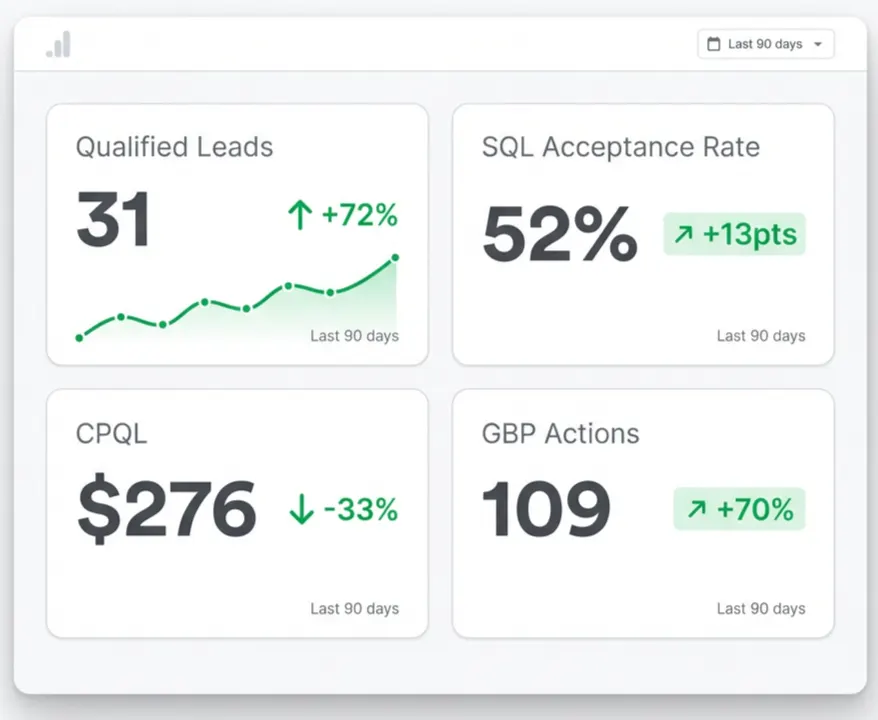
One SaaS product went from 18% to 42% activation once we took the friction out of its signup flow. The same discipline turns a practice site visitor into a booked appointment. See how we find and fix the path to conversion.
Medical practice website questions, answered
How much does medical practice website design cost?
Across the market, custom medical practice websites typically run $3,000 to $30,000 or more, driven mostly by how many services, providers, and locations need their own pages. Our starter builds begin at $2,500 for a single-location practice; most practices competing on condition and service searches land in the $6,000 to $15,000 range. Ongoing local SEO and content is separate, from $1,500 a month.
Why does listing accepted insurance matter so much?
It is one of the first things patients check on a practice website. A patient who cannot confirm you take their plan usually leaves rather than calling, so a vague mention costs more visits than almost any design problem. Publishing the list also cuts the phone volume your front desk fields all day, which is why it is usually the first thing we fix.
Does the site need to be HIPAA compliant?
If you are a covered entity, yes, for any part of the site that collects health information. That means HTTPS, a genuine privacy notice, sensible retention, and a Business Associate Agreement with any third party that processes patient data. Clinical detail should never arrive by ordinary email. We build to that standard by default, and your compliance counsel should sign off the privacy wording.
How important is accessibility for a healthcare website?
More than in most sectors. Practices serve patients with disabilities and face real accessibility obligations, so we test rather than assume - keyboard navigation, contrast, labelled form fields, screen-reader behavior. It also overlaps heavily with the technical quality search engines reward, so it is rarely wasted effort.
Can you improve our local SEO without rebuilding the site?
Often, yes. If the site is technically sound and reasonably fast, most of the win is profile, citation, review, and service-page work, and we will tell you when that is the better spend. We recommend a rebuild when the site cannot be made accessible or fast, or cannot support a page per service.
Do you integrate with our scheduling system?
Yes. We work with whichever practice management or scheduling platform you already run rather than pushing you onto something new, and we test the whole booking path end to end. If the platform itself is the bottleneck we will say so, but switching is your decision and not a condition of the build.
How long does a practice website take to build?
A single-location starter site takes two to three weeks. A growth site with per-service pages, scheduling integration, and accessibility remediation takes three to five weeks. Migrating substantial existing content and rankings adds time, because mapping redirects properly protects the traffic you already have.
Do you build for multi-site practice groups?
Yes. The main risk is a service-by-location matrix that generates near-duplicate pages Google quietly discounts, which is what most template platforms produce. We design a structure where each page has a genuine reason to exist - its own providers, hours, services, and referral context.
Ready to build your next product?
Tell us what you're building. A senior engineer will help you scope it, plan it, and get it built fast, on a foundation that's ready for real users.